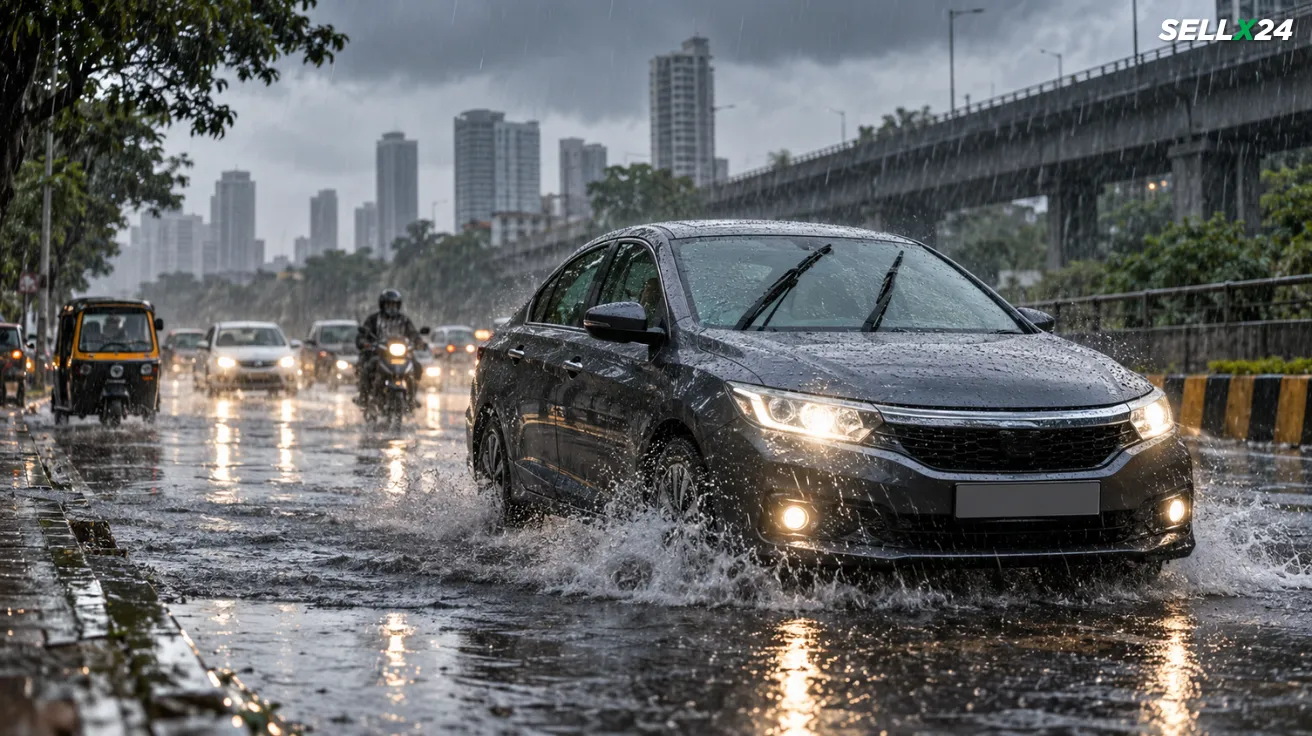
Most monsoon damage to cars in India isn't done by the rain. It's done in the ten seconds after a car stalls in a flooded underpass and the owner turns the key again. Good monsoon car care is mostly a set of cheap, boring habits that stop a two thousand rupee problem from becoming a two lakh rupee one. Twelve of them are worth your time, and the last one matters most if you're shopping for a used car this season.
1. Monsoon car care starts at the tyres, and 1.6 mm isn't enough
The Central Motor Vehicles Rules set 1.6 mm as the minimum tread depth for passenger cars, measured across the central three quarters of the tread. Treat that as the point where a tyre becomes illegal, not the point where it becomes unsafe. Wet grip falls off sharply below 3 mm, and independent braking tests suggest a tyre at the legal floor can need 25 to 40 percent more distance to stop on standing water than one with healthy tread. That gap is roughly the length of a car at the moment of impact. A tread depth gauge costs about ₹200 to ₹500. Check all four tyres in three spots each, since uneven wear also tells you something about your alignment.
2. Replace the wipers before they start smearing
Wiper blades die quietly. They keep wiping, just badly, and you find out at 70 kmph when the windscreen turns into frosted glass. If a blade chatters, smears, or leaves a band of unwiped water at the edge of its sweep, replace it. Blades are among the cheapest parts on the car and one of the few things you can fit yourself in five minutes. Fill the washer bottle while you're at it, and keep a spare bottle of plain water in the boot. Muddy spray off a truck uses more fluid than you'd expect.
3. Fix the lights, and stop using hazards while moving
Walk around the car with the lights on and check low beams, tail lamps, brake lamps and indicators. Fogged headlight lenses scatter light and cut your range, and internal fogging usually means moisture is already getting in. One habit worth dropping: switching on hazard lights while driving through heavy rain. It's common on Indian highways and it's a bad idea, because with hazards on your indicators stop working and nobody behind you knows when you're changing lanes. Use low beam, and the rear fog lamp if your car has one.
4. Buy the engine protection add-on before the water arrives
This is the gap most owners discover only after a claim gets rejected. A standard comprehensive policy pays for flood damage to the body, interior and electricals, but it usually excludes engine damage caused by water entering the engine, because insurers classify that as consequential damage. The cover for it is a separate engine protection add-on, commonly priced between ₹500 and ₹2,500 a year depending on the car. Engine repairs after water ingress start around ₹20,000 and run into lakhs. Some insurers only offer the add-on on cars up to five years old, so read the policy wording rather than assuming.
5. If the car stalls in water, do not turn the key
The most expensive thing you can do in a flooded street is attempt a restart. The engine tries to compress water, water doesn't compress, and something inside gives way. That's hydrostatic lock, and it bends connecting rods and cracks pistons. Insurers exclude it from the base policy precisely because they consider it avoidable. Switch off, leave the ignition alone, get everyone out, disconnect the battery if you can reach it safely, and call for a flatbed tow. A tow costs a few thousand rupees. A rebuilt engine doesn't.
6. Clear the drain holes you've never looked at
Every car has them: small openings at the bottom of the doors, under the boot lid, in the sunroof tray and at the base of the windscreen cowl. They clog with leaves, dust and insect nests, and once blocked, water backs up into the door card, the footwell or the roof lining. Run a length of trimmer wire or a thin cable tie through each one before the season and again midway through. Damp carpets in a modern car mean corroded connectors, and corroded connectors produce electrical faults nobody can trace.
7. Dry the cabin out, or live with the smell all year
Wet mats in a closed car will grow mould within a couple of days in Indian humidity. Take rubber mats out and dry them in whatever sun you get instead of leaving them in place. Run the AC on fresh air rather than recirculation for the first few minutes of a drive, and run the blower with the AC on for a few minutes before you park, which dries the evaporator and kills the musty smell at its source. If the smell is already there, the cause is under the carpet, not on it.
8. Test the brakes after every deep puddle
Wet discs and pads don't bite properly. After driving through standing water, press the brake pedal lightly for a few seconds while moving slowly, so friction dries the surfaces. Do it before you need to brake hard, not while you're braking hard. Handbrakes are the other seasonal casualty: leaving a cable-operated handbrake engaged for days in wet weather can seize the cable, so on flat parking, leave the car in gear instead.
9. Wash the underbody more often than you wash the paint
Owners polish the panels and ignore the part that's actually rusting. Floodwater in Indian cities carries silt and sewage, and near the coast it carries salt. All of it settles in the wheel arches and along the underbody and stays there. Rinse the underbody after any drive through standing water. If the car is past three or four years and you live in a flood-prone city, an anti-rust underbody treatment earns its cost, though quotes vary sharply by city and workshop, so get two or three before committing.
10. Check the battery terminals and the earth points
Damp mornings demand more from a battery than dry ones. Look for white or green crust on the terminals, clean it off, and smear a thin layer of petroleum jelly to keep moisture out. Then check the earth strap where it bolts to the body, a common corrosion point and a common cause of odd electrical behaviour. If your battery is three years old and already cranking slowly, replace it now rather than at 11 pm in a waterlogged lane.
11. Read the water before you drive into it
A rule worth memorising: if the water is deeper than half your wheel, turn around. Air intake height, not ground clearance, decides whether water reaches your cylinders, and on most hatchbacks and sedans that intake sits low in the engine bay. Don't follow a bigger vehicle in and assume you'll be fine. Watch where the bumper of the car ahead sits in the water. If you must cross something shallow, go through in first gear at steady revs without stopping midway.
12. Inspect any used car for flood damage before you pay
Every monsoon pushes a fresh batch of water-damaged cars into the resale market, cleaned up and priced to look like a bargain. Check five things. Sit inside with doors and windows shut for fifteen minutes and smell for damp or an aggressive air freshener. Pull each seatbelt fully out and look for a stain line. Check the seat rails and under-seat bolts for rust. Look for dried silt in the spare wheel well. Check the headlights for fogging inside the lens. Any two of those together and you should walk. Whether you're buying privately or through a marketplace like sellx24.com, insist on a lift inspection, and check registration and insurance status on the Parivahan Vahan portal, which won't flag flood history directly but will show ownership and cover patterns worth questioning.
None of this is difficult. Tread depth, working wipers, open drain holes, one insurance add-on and the discipline not to turn the key are what separate a wet season from an expensive one. The rules, fees and policy terms described here reflect current information, and the central government, state transport authorities and individual insurers can revise them at any time, so confirm specifics with your RTO or insurer before acting on them.
FAQs
1. How to take care of your car in the rainy season?
Keep tyre tread above 3 mm, replace worn wipers, clear the door and sunroof drain holes, and add an engine protection cover to your policy. Dry the brakes after deep puddles, park on higher ground, and never restart an engine that has stalled in standing water.
2. Does car insurance cover engine damage from flooding in India?
A standard comprehensive policy pays for flood damage to the body and interior but usually excludes engine damage caused by water entering the engine, which insurers treat as consequential. You need an engine protection add-on, which commonly costs ₹500 to ₹2,500 a year and varies by insurer.
3. How do you check if a used car is flood damaged?
Sit inside with the doors shut for fifteen minutes and smell for damp or heavy air freshener. Pull each seatbelt fully out and look for stain lines, check the seat rails and under-seat bolts for rust, look for dried silt in the spare wheel well, and check the headlights for fogging inside.
4. What is the minimum legal tyre tread depth in India?
The Central Motor Vehicles Rules require at least 1.6 mm across the central three quarters of the tread for passenger cars. That is a legal floor, not a safe one. Wet braking distances rise sharply below 3 mm, so replace tyres at 3 mm if you drive in heavy monsoon rain.
5. What should you do if your car stalls in water?
Do not turn the key again. Restarting pulls water into the cylinders and causes hydrostatic lock, which bends connecting rods and turns a cleanable problem into an engine rebuild. Switch off, get everyone out safely, disconnect the battery if you can reach it, and call for a flatbed tow.